
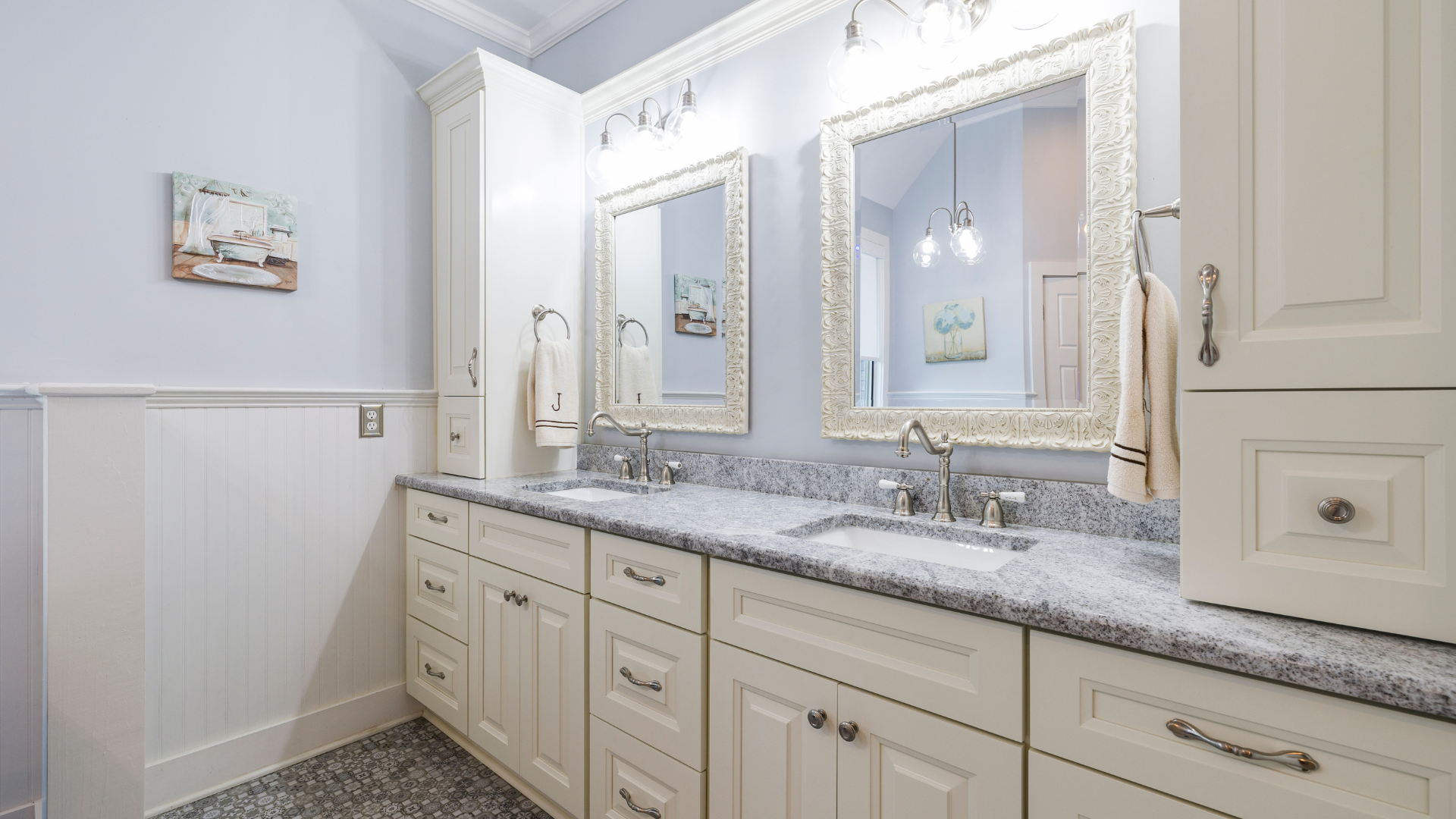
You know that feeling when you walk into a beautifully finished bathroom, and everything just seems to belong? The vanity feels right, the countertop complements it, the flooring adds warmth, and even the smallest fixture looks intentionally chosen. Nothing is shouting for attention, yet nothing feels out of place.
That kind of harmony rarely happens by accident.
Choosing a bathroom cabinet colour is easy. The tricky part begins when you place it beside a countertop, then add flooring, faucets, cabinet hardware, lighting, mirrors, and tile. Suddenly, a warm white looks too yellow, a grey floor feels too cool, or a beautiful countertop competes with the vanity you fell in love with at first sight.
For homeowners considering bathroom and kitchen cabinets in Saanich, the challenge is often finding that balance between personal taste and a bathroom that feels intentionally designed.
The key is to make your cabinetry, countertop, flooring, and fixtures work as parts of the same visual story. Here is how to approach each choice without making the process unnecessarily complicated.
Where Should You Start When Choosing Bathroom Finishes?
Trying to select everything at once can make a bathroom renovation feel more confusing than it needs to be.
A better approach is to establish one strong starting point and build the rest of the room around it. For many homeowners, that starting point is the vanity because it occupies a significant visual area and also determines much of the bathroom’s storage and layout.
Once you have the cabinet style and colour, you can work outward.
Consider the following order:
- Cabinetry: Decide on the door style, colour, material, and overall character of the vanity.
- Countertop: Choose a surface that complements the cabinetry without competing.
- Flooring: Use the floor to support the palette, either by creating contrast or maintaining a similar tonal range.
- Fixtures and hardware: Bring in metal finishes that connect the larger elements without overwhelming them.
- Walls and accessories: Use paint, tile, mirrors, lighting, and accessories to complete the room.
This sequence helps prevent a common problem: selecting several attractive finishes individually that do not work particularly well together.
How Should Bathroom Cabinets and Countertops Work Together?
Your cabinet and countertop do not have to be the same colour. In fact, contrast can add depth to a bathroom.
The trick is to identify each material’s undertones and visual weight.
- Pair Warm Cabinets With Warm or Balanced Surfaces
Wood cabinetry, beige finishes, and warm whites generally pair comfortably with countertops that have cream, taupe, beige, or subtle warm veining.
That does not mean every element needs a warm undertone. A neutral countertop can bridge warmer cabinetry and cooler wall or floor finishes. - Let One Surface Take the Lead
If your countertop has prominent veining, a simpler cabinet finish can allow the stone to become the focal point.
Likewise, if you select cabinetry with noticeable wood grain, a quieter countertop can keep the room from feeling visually busy.
This principle is especially useful when planning custom bathroom cabinets because you can consider the cabinetry, countertop, and storage together rather than purchasing them as unrelated components. - Consider the Amount of Contrast
High contrast can create a dramatic bathroom. Low contrast can create a softer, more seamless look.
For example, dark cabinetry against a pale countertop creates definition, while light cabinetry with a similarly toned countertop can make the vanity appear more integrated into the room.
Neither approach is automatically better. The right choice depends on the atmosphere you want to create.
Should Flooring Be Lighter or Darker Than Cabinets?
No universal rule says flooring must be lighter or darker than the cabinets. Both approaches can work.
A darker floor beneath lighter cabinetry can visually ground the vanity and create a clear separation between the different surfaces. This works especially well when the room has plenty of light, and the flooring has a subtle texture or pattern.
Lighter flooring with darker cabinetry creates a different effect. The floor can keep the lower part of the room feeling bright while making the vanity a stronger focal point.
You can also keep both within a similar tonal family. For example, warm beige cabinetry paired with slightly deeper stone-look flooring can create a layered appearance without introducing a strong colour contrast.
When deciding, look at more than colour alone. Tone, undertone, texture, pattern, and lighting all influence how the combination will appear.
A Simple Way to Test the Combination
Before committing to materials, place your cabinet sample, countertop sample, flooring sample, and fixture finish together under the lighting you’ll use in the bathroom.
A combination that looks balanced under showroom lighting may appear warmer, cooler, darker, or lighter at home.
Seeing the materials side by side gives you a much better sense of whether the overall palette feels intentional.
How Do You Coordinate Bathroom Fixtures With Cabinetry?
Fixtures include more than the faucet. Depending on the bathroom, you may also be coordinating shower hardware, cabinet handles, towel bars, lighting, mirrors, and other metal elements.
You don’t need every metal finish to match, but the combination should make sense.
Choose a Dominant Metal
For a straightforward approach, choose one main finish for your hardware and plumbing fixtures.
Matte black can create a crisp, contemporary appearance. Brushed nickel offers a softer, understated look. Brass can add warmth and a more decorative quality.
The cabinet colour should support that decision, not compete with it.
Mixing Metals Can Work
A bathroom can include more than one metal finish if the combination feels deliberate.
For example, you can repeat a primary faucet finish through cabinet hardware, while another metal appears in a smaller lighting or accessory detail.
The important point is proportion. If you introduce several metals in equal amounts, the room can start to feel visually fragmented.
How Can You Balance Colour, Texture, and Pattern?
A bathroom can contain several materials without looking chaotic if each one has a defined role.
Think of the room in three layers. Colour establishes the overall mood. This includes cabinetry, walls, flooring, and large tile areas.
Texture gives the room depth. Wood grain, stone, matte finishes, textured tile, and brushed metals can prevent a neutral bathroom from feeling flat.
Pattern creates visual interest. Veined countertops, patterned tile, or decorative flooring can provide a focal point.
Problems often arise when all three are competing for attention.
If the floor has a noticeable pattern and the countertop has strong veining, simpler cabinetry may create a better balance. If the cabinetry is highly distinctive, quieter surrounding surfaces can give it room to stand out.
This approach is especially helpful when selecting bathroom storage cabinets with doors because storage doesn’t have to dominate visually. Well-planned cabinetry can provide substantial function while letting other design elements add character.
How Do You Match Finishes in a Small Bathroom?
Small bathrooms benefit from careful visual planning because every finish takes up a noticeable portion of the room.
A lighter overall palette can make the space feel more open, but that does not mean you have to avoid darker cabinetry.
Instead, consider where you introduce contrast.
A darker vanity can become a deliberate focal point against lighter flooring and walls. Alternatively, cabinetry that closely matches the wall colour can create a more continuous look.
The vanity size also deserves attention. A large cabinet in a compact bathroom can dominate the room, while insufficient storage can leave countertops crowded.
This is one area where custom bathroom vanity cabinets can be particularly useful. You can plan the dimensions, drawer configuration, finish, and storage around the actual room instead of forcing a standard unit into the available space.
Why Consider Custom Cabinetry for a Coordinated Bathroom?
A cohesive bathroom is easier to achieve when you can consider cabinetry alongside other finishes from the start.
Custom cabinetry gives homeowners more flexibility to coordinate:
- Vanity dimensions
- Door styles
- Cabinet colours
- Countertop selection
- Storage configuration
- Hardware
- Open and closed storage
- Surrounding architectural details
It also allows the design to respond to practical constraints.
A wall may be slightly narrower than expected. Plumbing may occupy an inconvenient location. A homeowner may want additional drawers rather than traditional cupboard storage. Or a vanity may need to accommodate two sinks without overwhelming the room.
Rather than treating these details as obstacles, custom design can incorporate them into the overall plan.
For homeowners considering cabinetry for a renovation involving bathroom and kitchen cabinets in Saanich, this approach can also help create visual continuity across different areas of the home without making the rooms look identical.
How Can Seaside Cabinetry & Design Inc Help Coordinate Your Bathroom?
Choosing cabinet colours and finishes is much easier when you can evaluate the materials as a complete design rather than making each decision separately.
Seaside Cabinetry & Design Inc takes a design-led approach that can help homeowners work through those choices from the initial layout to installation.
What our approach brings to a bathroom project:
- Design experience: With more than 40 years of combined cabinetry and design experience and over 800 projects delivered, our team can help homeowners consider layout, storage, finishes, and everyday usability together.
- A complete visual plan: Professional layouts and realistic 3D renderings allow you to see how cabinetry, colours, hardware, and other design details can come together before final installation.
- A broad range of cabinetry choices: Merit Kitchens, Columbia Cabinets, and Lectus provide hundreds of door styles, finishes, and options, giving homeowners flexibility when developing a bathroom palette.
- Guidance beyond the cabinets: We also work with countertops, sinks, and plumbing fixtures, making it easier to coordinate the major elements rather than choosing each component in isolation.
- Material choices suited to different designs: Whether you want a warm wood-inspired vanity, a clean contemporary finish, or a more traditional cabinet profile, you can consider the available options alongside your countertop and fixture selections.
- Warranty options for added confidence: Merit Kitchens and Columbia Cabinets include limited lifetime warranties, while Lectus cabinets come with a limited five-year warranty.
The benefit of this approach is simple: you are not just choosing a cabinet colour. You are building a bathroom palette where the cabinetry, countertop, flooring, and fixtures have been considered together.
The Bottom Line
A beautifully coordinated bathroom does not require every finish to match. In fact, some of the most inviting spaces use contrast thoughtfully, combining different colours, textures, and materials while keeping the overall palette connected.
Start with the cabinetry, establish the countertop relationship, decide how the flooring should support the room, and then use fixtures and hardware to tie the details together. Pay attention to undertones and lighting, and always view samples side by side before deciding.
Most importantly, design around how you’ll actually use the bathroom. A beautiful vanity that lacks useful storage will quickly become frustrating, while a practical cabinet layout with carefully chosen finishes can make the room feel both polished and comfortable.
If you are planning a bathroom renovation and want help choosing cabinetry, countertops, fixtures, and finishes that work together, we can help you develop the design from the ground up. Book a design consultation with Seaside and start building a bathroom that looks considered from every angle.
Seaside Cabinetry & Design Inc serves homeowners throughout North Saanich, Sidney, Central Saanich, and Saanich, as well as Victoria, Esquimalt, Oak Bay, Langford, Colwood, View Royal, Highlands, Metchosin, and Sooke.
FAQs
Should flooring be lighter or darker than cabinets?
Either option can work depending on the size, lighting, and overall colour palette of the bathroom. Darker flooring can ground lighter cabinetry, while lighter flooring can help darker cabinets stand out without making the room feel heavy.
Should bathroom countertops match the cabinets?
Bathroom countertops do not need to match the cabinets exactly. Choosing complementary tones, textures, or contrast levels can create a more layered and visually interesting bathroom.
What colour cabinets make a small bathroom look bigger?
Lighter cabinet colours can create a better, more open visual effect, especially when paired with light walls and flooring. However, a darker vanity can also work as a focal point when the surrounding finishes are kept relatively light.
Can I mix different finishes in a bathroom?
Yes, different finishes can work well when they have a clear relationship in colour, tone, or texture. Keeping one or two elements dominant and using other finishes as accents can prevent the room from feeling visually busy.
How do I choose a bathroom vanity colour?
Start by considering your flooring, countertop, wall colour, and the amount of natural and artificial light in the room. Then choose a vanity finish that either complements those elements closely or provides intentional contrast.